
Visualizing Vector Addition
Presents graphically what adding two vectors represents.
One of the most basic laws about adding numbers is that if [color="#8B0000"]A + B = C[/color], then [color="#8B0000"]B + A = C[/color] is also true. Likewise, if [color="#8B0000"]A + B + C = D[/color], then [color="#8B0000"]A + C + B = D[/color], and [color="#8B0000"]B + A + C = D[/color], and [color="#8B0000"]B + C + A = D[/color], and [color="#8B0000"]C + B + A = D[/color], and [color="#8B0000"]C + A + B = D[/color]. No matter which order you add the numbers, they always add up to D.
The same rule holds true when adding Vectors (groups of numbers). The way you add vectors is you take the first components and add them together to produce the first component of the resulting vector, take the second components of the vectors and add them together, and continue until all components are added. Vectors are commonly only 2 component or 3 component, to represent points in 2D (flat) and 3D space, but they can be more. To add [color="#8B0000"](6, 2) [/color]with [color="#8B0000"](11, 3)[/color], the result is [color="#8B0000"](6 + 11, 2 + 3) [/color]or [color="#8B0000"](17, 5)[/color].
Now comes the fun part, visualization. This first picture shows 4 two-dimensional vectors, all coming from the origin (point [color="#8B0000"](0, 0)[/color]).
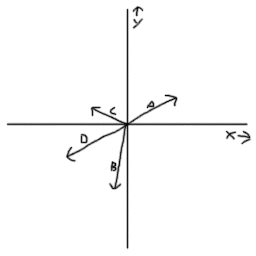
The following images show how to visualize adding the four vectors together. If you connect all the vectors together, head to tail, head to tail, starting at the origin and progressing through space, they will end up at a point which when considered as a vector itself starting at the origin, is the result vector of the addition. As with normal addition, the order you connect the vectors head to tail does not matter at all. In the three examples, the order is always different, but the final point always lands on the tip of the new vector [color="#8B0000"]E[/color], which is the result of the addition. This visualization trick works in 3D as well as 2D.
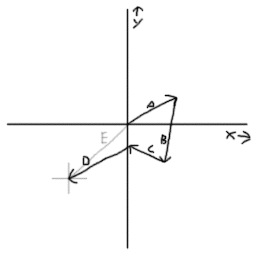
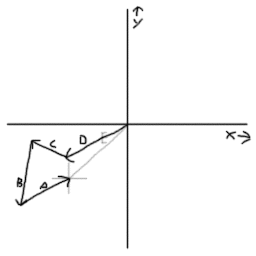
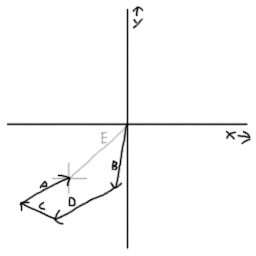
Vector Subtraction can be visualized in the same way, except that when you subtract a vector, you stick its head to the point where its tail would normally attach, and as with normal subtraction, the order in which you subtract vectors DOES matter. You can use visualization to help make sure you're subtracting vectors in the right order.
Copyright 1998-1999 by Seumas McNally.
No reproduction may be made without the author's written consent.
Courtesy Of Longbow Digital Artists
Related Tutorials

A Day As A Game Designer
The fabled game designer. The man, the myth, the legend behind the game. An inspiration to young creatives who wish to …
 Kai Wüest

So You Want to be a Game Developer?
Battletech tools developer Chris Eck describes his journey and advice for getting a job in the industry.
 Chris Eck
A Quick Guide to Gamification and Gamification Careers
If you find yourself slightly stumped over the ever-growing buzz around gamification, and unsure whether there is any o…
Sophie Jackson

Raph Koster's Postmortems: Una Carrera
This excerpt from Raph Koster's Postmortems is an adaptation from a speech he delivered at GameDay Peru in early 2015. …
Raph Koster

Negotiating Sign-On Bonuses in the Games Industry
A quick blurb on signing bonuses in the games industry and how to approach asking for one.

A LinkedIn Profile for Job Hunting and Networking
Marc Mencher is founder and CEO of GameRecruiter and author of Get in the Game!, an instructional book on building a ca…
Discussion
More from Seumas McNally
Comparing Shadow Mapping Techniques with Shadow Explorer
New Incentives and a Whole New Platform From The Intel AppUp developer program
The final installment in this series on Intel's AppUp program details additional incentives and opportunities for devel…
The Game Maker
This book excerpt contains the first chapter of the book that introduces beginning game developers to the Game Maker pr…
Discussion