
Lens Flare Tutorial
This is a simple, well written tutorial for implementing increasingly popular lens flares.
To explain how to create the over-used, totally hyped "Lens Flare" effect that everyone seems to be talking about these days.
"Did you see the screenshots for , they had the coolest Lens Flares!!!"
[size="5"]Assumptions
I assume that you are familiar with 2d coordinate systems.
I assume that you are capable of using blit to compose the image.
[size="5"]Explanation of the Concepts
The basic idea is that when a bright light passes in front of a camera in real life, it typically creates a glare on each of the lenses within your camera. The physics of why and how the optics of lens flares work are irrelevant to achieving a believable effect.
Now, in your typical polygon-based 3d engine, you don't actually use multiple lenses in your calculations so we need to find a way to "fake" the illusion that the light is glaring off of several lenses within your virtual camera.
[size="3"]Ingredients:
The position of the center of the screen in screen coordinates(cx,cy).[/bquote]
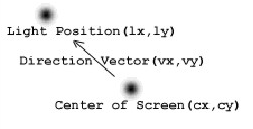
// find the direction vector from the center to the light
 vx = cx - lx;
vy = cy - ly;NOTE: STORE THE LENGTH OF THE VECTOR...we'll call ours "length"
You'll also need several images to use as components of the effect. One of these images is typically a star-burst type of image. The others are usually halo type images. See below.
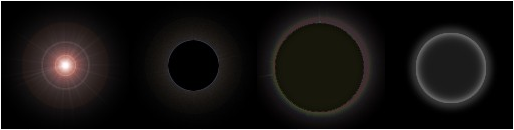
OK, so now we have three vectors:
lx,ly = position of the light
vx,vy = normalized direction vector from the center to the light[/bquote]
Here comes the easy part...
Simply scale the normalized direction vector by the length to get the center coordinate of where to draw the primary "star-burst" image.
vx = vx * distance;
vy = vy * distance;top = vy - 64 + cy;
left = vx - 64 + cx;
right = vx + 64 + cx;
bottom = vy + 64 + cy;
// NOTE: MAKE SURE TO OFFSET BY THE CENTER POINTI've found the following values to work quite well...
| Flare | Length Scale | Image Scale |
| Primary Flare | length | 1.0 |
| First Halo | length/2 | .5 |
| Small Burst | length/3 | .25 |
| Next Halo | length/8 | 1.0 |
| Next Burst | -(length/2) | .5 |
| Next Halo | -(length/4) | .25 |
| Next Burst | -(length/5.5) | .25 |
Below you can see a shot of the effect at work...Notice the lack of proper alpha-blending, this was due to the fact that I slapped the lens flare test project together with C++ Builder using straight SRCAND-style "blits"...gets the point across and only took about a half-hour to code...
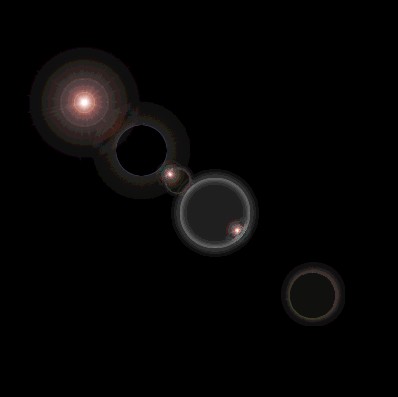
For an actual high-quality example of this algorithm at work, be sure to download the Venom demo on March 2, 1998.
I hope you have enjoyed this short tutorial, if you have any questions or would like the source code to the C++ Builder project that this screen shot is from, send me an email.
-[email="3dguy@mediaone.net"]Alan Gordie[/email]
Reprinted with Permission
Related Tutorials

Procedural Generation of 2D Tile Maps in Games
The article explains how to build a procedural 2D cave map generator using cellular automata. It covers map representat…

Localizing A Game Into French — Which Variant Should You Choose?
So, you’re making an awesome indie game, and now you’re thinking about localizing it into French? Great idea! There ar…
 Level Up Translation

How Long Does It Take To Localize An Indie Game?
So you’re planning on localizing your indie game, but you’re not sure how much time to schedule in. While the timing o…
Level Up Translation

Creating game videos: best practices and pitfalls to avoid
Game video production: practical tips on how to create a game trailer or teaser that you can be proud of. Give your aud…
 Alconost

Adopting CI/CD: How Midwinter Entertainment iterates at speed with the help of IMS
Game development was once like one long sprint: a huge effort until you reached the finish line — at which point you co…
 GameDev.net

5 Things to Consider When Making a Video to Promote Your App or Game
How can you show an app or game in your video in a way that attracts new users? Let’s take a look at what to go by when…
Alconost
Discussion
More from Alan Gordie
Comparing Shadow Mapping Techniques with Shadow Explorer
New Incentives and a Whole New Platform From The Intel AppUp developer program
The final installment in this series on Intel's AppUp program details additional incentives and opportunities for devel…
The Game Maker
This book excerpt contains the first chapter of the book that introduces beginning game developers to the Game Maker pr…
Discussion