

What do you like about that language you use?
Do you prefer verbose over terse languages or vice versa?
After checking hello world programs in more than 50 programming languages, it makes me wonder why a person will make a language more complex than machine code.
There's the overly unreasonably terse malboge which in order to write helloworld involves no letter or number but a combination of unrelated symbols. There is also the overly verbose supernova which involves english language and nothing else.
There are also some things in some languages that look absolutely wrong. In php, you have to put '?' to print out something and somethings in c++.
There are also languages i believe should be fined/banned, e.g. brainfuck. It is easier to use assembly than malboge.
So what do you like about your programming language and makes it different.
Thanks for reading and replying
What's in a language that makes you like it
I have used many, though I haven't heard of some of those you mention.
I generally view languages in terms of how they rate on four scales (in increasing order of importance):
1) Ease of use (I love ASM, so I don't mean that... I mean things like clarity, type safety, readability, OOP, organization ability, etc.)
2) Tools support (I hate languages without killer tools to develop in)
3) Performance (who wants to write good code that performs badly? Depending upon the project, this can #1)
4) Platform support (if I need to support multiple platforms, I'd like to get that nearly free)
I enjoy programming in C++ the best, with occasional inline ASM blocks where I need the best performance. But, for most of the work I do lately platform support is far more important than performance, so I choose Java: similar organization capability and readability, vastly superior platform support, approximately equal tool quality.
I like to get the job done, as quickly as possible, and end up with something I'm proud of. This can be done in just about any language, depending upon the requirements.
Do you know Malbolge is named after the 8th circle of hell? To criticize it for being hell to program with is criticizing it for living up to its name.
that explains and is really weirdDo you know Malbolge is named after the 8th circle of hell? To criticize it for being hell to program with is criticizing it for living up to its name.
that explains and is really weirdDo you know Malbolge is named after the 8th circle of hell? To criticize it for being hell to program with is criticizing it for living up to its name.
Google esoteric languages , there are tons of them, most of them are created as a joke or simply to test how far you can take language design and still get a "usable" result
, They are not intended to be used for real work.
Most serious programming languages have atleast some advantage.
Also, you don't have to put a '?' to print out anything in php ?
echo 'Hello World';
is all you need in php.
The
that explains and is really weirdDo you know Malbolge is named after the 8th circle of hell? To criticize it for being hell to program with is criticizing it for living up to its name.
It's an esoteric language. That's kind of the point. Here is a little detail from the creator.
As far as what I want from a language, I'm not very picky. I want it to be straightforward where if it looks like it is doing A, it is actually doing A. All commonly used languages seem to pass this requirement. I also don't want a restrictive language. Prolog fails in this regard, so you wind up doing half your work in a different language. It wouldn't have been as bad if the switching wasn't on an almost daily basis. Then it would be more like inline ASM code, which I don't mind at all.

For the paid job I want a language which is productive: it must drive me to the point quickly. C#.
For my own projects I want a language which is beauty on the page, elegant, with a nice syntax. Obviously, these are all very subjective points, and in effect I choose C++, which is ugly and terrible for the most.
For me, there's no elegance in $variable things, or [object pleaseDo:something andThen:somethingElse using:allThat]. I lose myself when there are no brackets too, like in those languages indent-based.
Plain C is beatifull too.
I use which ever language gets the job done. At the moment that tends to be Objective C, C++, Java and Javascript with a small amount of Ruby or Shellscript. All of these I would say are Ugly and rather inelegant languages but the thing I like about them is they get the job done.
If I could choose a favorite language though it would have to be commom lisp.
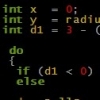
for me language is the playground, i like the language to do thiings in the playground in many free not constrained ways and this is c [though i dislike its ugly syntax for passing values in and out from functions using & and * its burdensome for me]
What do you like about that language you use?
Do you prefer verbose over terse languages or vice versa?
After checking hello world programs in more than 50 programming languages, it makes me wonder why a person will make a language more complex than machine code.
There's the overly unreasonably terse malboge which in order to write helloworld involves no letter or number but a combination of unrelated symbols. There is also the overly verbose supernova which involves english language and nothing else.
There are also some things in some languages that look absolutely wrong. In php, you have to put '?' to print out something and somethings in c++.
There are also languages i believe should be fined/banned, e.g. brainfuck. It is easier to use assembly than malboge.
So what do you like about your programming language and makes it different.
Thanks for reading and replying
- It doesn't force me on a programming paradigm or a programming style, it doesn't put limitations on debugging (especially on virtual memory), it allow to combine with other language in some ways, it doesn't put strong limitation on system environment (ie: no proprietary hardware or operating system)..
- I am the personification of verbosity (and the Antichrist of prefixes and Hungarian, and that's a little funny since there are mostly used in my favourite languages).
- "Hello, world!" programs alone aren't suffice to choose, like or dislike a language but sometimes they are enough to discard a language if I see something I really dislike (as example: I really dislike "off-side rule" and really hate case insensitive programming languages).
- I think in every language there is "something wrong", sometimes due historical reasons, sometimes due companies/corporations will, sometimes due the stupidity of standardization consortium rules..
- Most of "very wrong/bad" programming languages die "quickly", unfortunately that's not always true (COBOL should be extirpate for the universe and it's books and documentations burned in hell's flames).
yeah, i was wondering what was the importance of pointers.for me language is the playground, i like the language to do thiings in the playground in many free not constrained ways and this is c [though i dislike its ugly syntax for passing values in and out from functions using & and * its burdensome for me]
I just found out yersterday that Dim blah As Integer is equivalent to int blah; and was wondering why they had to use 'Dim' instead of 'Create/Make Integer blah or make blah integer' or even why it had to be english.
From lua's wikipedia article, it looks so much easier.
i know 'hello world' shouldn't be used to judge a language but it is the easiest most understandable code you can write with a language and few make it look super easy. The easiest is J programming language, followed by lua or perl or ruby (they use similar methods). In Java, it looked so complicated and assembly actually looked easy.
What do you like about that language you use?
Do you prefer verbose over terse languages or vice versa?
After checking hello world programs in more than 50 programming languages, it makes me wonder why a person will make a language more complex than machine code.
There's the overly unreasonably terse malboge which in order to write helloworld involves no letter or number but a combination of unrelated symbols. There is also the overly verbose supernova which involves english language and nothing else.
There are also some things in some languages that look absolutely wrong. In php, you have to put '?' to print out something and somethings in c++.
There are also languages i believe should be fined/banned, e.g. brainfuck. It is easier to use assembly than malboge.
So what do you like about your programming language and makes it different.
Thanks for reading and replying
- It doesn't force me on a programming paradigm or a programming style, it doesn't put limitations on debugging (especially on virtual memory), it allow to combine with other language in some ways, it doesn't put strong limitation on system environment (ie: no proprietary hardware or operating system)..
- "Hello, world!" programs alone aren't suffice to choose, like or dislike a language but sometimes they are enough to discard a language if I see something I really dislike (as example: I really dislike "off-side rule" and really hate case insensitive programming languages).
- I think in every language there is "something wrong", sometimes due historical reasons, sometimes due companies/corporations will, sometimes due the stupidity of standardization consortium rules..
From your post, it seems like you use c++ which is multiparadigm, case sensitive etc.
Why hasn't any language be made as fast as C? Lua is like 10x slower than C even though it's like the fastest scripting language.
What would happen if lua were a compiled language?
yeah, i was wondering what was the importance of pointers.for me language is the playground, i like the language to do thiings in the playground in many free not constrained ways and this is c [though i dislike its ugly syntax for passing values in and out from functions using & and * its burdensome for me]
I just found out yersterday that Dim blah As Integer is equivalent to int blah; and was wondering why they had to use 'Dim' instead of 'Create/Make Integer blah or make blah integer' or even why it had to be english.
Dartmouth BASIC (1960's) is the source of Dim in BASIC. It was only used to declare the dimensions of an array back then. Even the BASIC I used in the 1990's did not have any declarations for non-array variables.
Do you mind if a language is slow or fast like C or C++? C++ seems to be used by most because of its speed and the fact that its multiparadigm.
Why hasn't any language be made as fast as C? Lua is like 10x slower than C even though it's like the fastest scripting language.
What would happen if lua were a compiled language?
Speed of the language is absolutely important when choosing a language for a project, but it doesn't really matter on a day-to-day basis. Even in a large project, your tests being run are usually small enough that running 100x slower than a release build wouldn't matter. Sometimes it does, but not as often as students seem to think.
No language winds up as fast as C because C does so little. It basically only adds things to the spec once compilers have gotten so good at the particular feature that the performance will be excellent. Also, most other languages are built either directly or indirectly using C (ex. allowing the ability to link to C libraries is common). Just imagine trying to write an interpreter with Lua that is faster than Lua. Pretty hard to do.
i know 'hello world' shouldn't be used to judge a language but it is the easiest most understandable code you can write with a language and few make it look super easy. The easiest is J programming language, followed by lua or perl or ruby (they use similar methods). In Java, it looked so complicated and assembly actually looked easy.What do you like about that language you use?
Do you prefer verbose over terse languages or vice versa?
After checking hello world programs in more than 50 programming languages, it makes me wonder why a person will make a language more complex than machine code.
There's the overly unreasonably terse malboge which in order to write helloworld involves no letter or number but a combination of unrelated symbols. There is also the overly verbose supernova which involves english language and nothing else.
There are also some things in some languages that look absolutely wrong. In php, you have to put '?' to print out something and somethings in c++.
There are also languages i believe should be fined/banned, e.g. brainfuck. It is easier to use assembly than malboge.
So what do you like about your programming language and makes it different.
Thanks for reading and replying
- It doesn't force me on a programming paradigm or a programming style, it doesn't put limitations on debugging (especially on virtual memory), it allow to combine with other language in some ways, it doesn't put strong limitation on system environment (ie: no proprietary hardware or operating system)..
- "Hello, world!" programs alone aren't suffice to choose, like or dislike a language but sometimes they are enough to discard a language if I see something I really dislike (as example: I really dislike "off-side rule" and really hate case insensitive programming languages).
- I think in every language there is "something wrong", sometimes due historical reasons, sometimes due companies/corporations will, sometimes due the stupidity of standardization consortium rules..
From your post, it seems like you use c++ which is multiparadigm, case sensitive etc.
Yes, I like C++11 and also Java, but for different targets/purposes.
Do you mind if a language is slow or fast like C or C++? C++ seems to be used by most because of its speed and the fact that its multiparadigm.
Why hasn't any language be made as fast as C? Lua is like 10x slower than C even though it's like the fastest scripting language.
What would happen if lua were a compiled language?
- I care only if I need a language that isn't itself a performance bottleneck. I also doubt that C++ is more used than C (think on all the embedded and industry system, or just at linux..)
- Don't know, maybe because C can be easily mapped/translated to ASM or machine code. Lua and C also have different purpose (dunno also if lua is the "fastest" scripting language").
- A compiled scripting language (maybe even a native compiled) would be a pain in the a...
Anyway I think it's better spending time to improve programming and engineering skills instead of searching a faster programming language.
So speed doesn't really matter?
Speed matters. You won't be seeing a AAA game engine made in Lua any time soon, although you might see tools for the game using Lua (WoW I think uses Lua for addons). The thing is speed of a language matters to a project manager, not to individual coders.
Do you mind if a language is slow or fast like C or C++? C++ seems to be used by most because of its speed and the fact that its multiparadigm.
Why hasn't any language be made as fast as C? Lua is like 10x slower than C even though it's like the fastest scripting language.
What would happen if lua were a compiled language?
Languages don't have "speed". their implementations do. (Allthough some language features in higher level languages can make certain optimizations very difficult for a compiler to perform) JIT compilation as it is used by Java and C# however has its own performance advantages but it is difficult to take advantage of them on the client due to the long startup delay you get if you try to do heavy optimization when the program starts, This is one of the reasons for Javas popularity on servers. The server JVM can greatly outperform todays C and C++ compilers in code that makes heavy use of dynamic dispatch for example.
Languages such as D and Go have the potential to be as fast as C or C++ (or even faster if they become more popular) but they're not popular enough (and probably never will be due to inertia), currently the best Go compiler is quite a bit slower than Oracles Java VM or Microsofts .Net.
The compiler is ultimatly responsible for generating "optimal" assembly. The opensource community, Microsoft, (Apple ??), and CPU manufacturers push millions of dollars into compiler R&D primarily for C++ due to its popularity(The OS and/or CPU with the best performing C++ compiler has a huge advantage over the competition since the compiler has such a big impact on the final performance.
Microsoft and Oracle also push quite a bit of resources into the .Net and Java runtimes but they are far harder languages to optimize due to the safety requirements (Java also suffers quite a bit from its early focus on the Sparc CPU architecture(parts of the language can't run natively on a x86 CPU).
When it comes to scripting languages such as Lua, Python, etc the only sane option is interpretation and JIT compilation (Having to recompile your scripts using a AOT compiler before you can test even a minor change would remove one of the biggest advantages you get from a scripting language and many of these languages allow you to create and modify functions, classes, etc at runtime and have the changes take effect immediatly (this is a huge advantage when you are tweaking gameplay code as you can enter your changes using a in-game console while the game is running, see the result immediatly and save or discard your changes as you see fit rather than having to recompile and restart the application every time you wish to test a small change)

Google esoteric languages , there are tons of them, most of them are created as a joke or simply to test how far you can take language design and still get a "usable" result
, They are not intended to be used for real work.
I beg to differ.
Go, for example, is making inroads in systems programming, and I find its declaration syntax much more elegant and readable than that of C/C++.
C++ is my language of choice, because a)I cut my programming teeth on C, and b)it is powerful (which can be a boon or a bane depending on whom you ask). But I fully agree with Bjarne Stroustrup's quote:
Within C++, there is a much smaller and cleaner language struggling to get out.
Topic Locked
This topic has been locked by a moderator. New replies are not allowed.