
Five and a Half Steps to Efficient Meetings
How to go about planning and running successful meetings

Meetings are boring!
Meetings are boring, overcrowded, take up much of your valuable time and don't produce the desired results. Or they can be interactive, efficient, goal-driven, interesting and sometimes even fun. So how to go about planning and running successful meetings?Five and a half Steps to successful meetings
Running successful meetings is not difficult; it just needs some preparation and a bit of practice. Before I go into the details on how to plan and run an efficient huddle I would like to state two very important point: If you call in a meeting, you are the one responsible to get the most out of it. It's your show, so while you might not be the main contributor to the content be sure you are the one to drive the meeting forward. Be the facilitator of discussions, be the one to help everybody to keep the focus and last but not least be the eye that watches the clock. As Slayemin put it so aptly in the comments below: "The ultimate purpose of a meeting is to reduce confusion and uncertainty. If people go into a meeting and they leave less confused or uncertain, then it was a good meeting. If people go into a meeting and come out with the same or greater amounts of confusionion, it was a poor meeting. As a meeting attendee, you are either the one who is confused and uncertain, or the one dispelling confusion for others." Step 1: Send out the agenda before the meeting. When you schedule a meeting prepare an agenda and send it to anybody involved. Preferably early enough so anybody can read through it and comment on the agenda if necessary. Tell everybody what this meeting will be about and what its goals are. This helps you also to keep the meeting on topic later on, as it prevents people from shoving in an extra discussion about something else. Having a clear agenda also helps to decide who needs to be in the meeting and who will waste his time as an over-passive listener. Step 2: Have a well structured Agenda Try to keep the agenda short and on topic, as this also helps to limit the scope of the meeting, which in turn helps people to sty focused. I structure almost all my meetings very similarly like this (Although often in a paraphrased way):- Introduction to the topic and the goal of the meeting. Take a few sentences to introduce the crowd to the topic you are about to discuss about. If there were any previous meetings to the topic do a short recap of them. And most important state the goal of this meeting as clearly as possible.
- Assess the points to discuss or the problems to solve. Break down the problem into smaller items that can be tackled in the time you have. Tell them something along the line of "In order to achieve XY we need to solve A, B, and C and I would like to discuss this in this order".
- Discuss the points or solving the problems. Now go along and discuss the items you brought up. Take notes or have someone take them for you.
- Define action items to carry out. Assign how to continue after the meeting. Assign the action items to a person and have them write their todos down.
- Conclusion & define follow up meetings. Wrap up the meeting by going through your notes again and communicate what you expect to be done until the next meeting or deadline on the topic.
Using this on different kinds of meetings
Meetings can span a very large range from all-out creative brainstorming sessions to the dry presentation of your new company regulation on home-office work. While the five steps fit any kind of meetings, they can be tailored a bit to fit any particular style of meetings. I tend to place my meetings into four overlapping categories to get a first grip on how I want to run a meeting and what to expect as outcome. The boundaries between the categories are fluid but knowing in which area I am usually helps me in setting up the agenda and time frame of a meeting.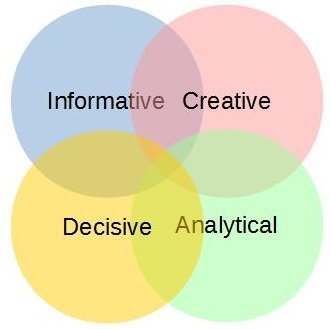
- Informative: The purpose is to fill in the attendees with certain kind information, frontal presentation is often the way to go, but restrain yourself from droning away. Keeping your audience's attention up is one of the key challenges. Having a clear and focused agenda that helps people follow up the progress of the meeting and stopping any unnecessary babble helps to avoid losing the audience. Your job as the facilitator of the meeting is to get the facts across in a concise manner and answer any questions from your audience to their satisfaction.
- Creative:Usually the most interactive kind of meeting. You try to find out something new, whether an artsy brainstorming session or a technical design meeting usually you get the crowd to participate. Challenges are to restrain run-away discussions and actually find a conclusion while not restraining the people from getting new ideas in. As the runner of the meeting you are responsible that your creative process runs smoothly and ensure and document the progress of any discussions and ideas.
- Decisive: You got the facts laid out but you need to find a decision on something where the facts are already laid out but might be conflicting or not yet fully understood. Often combined with the informative meeting, the challenge here is to actually get a decision to made and responsibilities cleared. To keep these kinds of meetings short having a pre-read where everybody can get up to date in his or her own time helps shorten these meetings. Time boxing these meetings helps to avoid running a discussion in circles, sometimes one has to agree to disagree but still decide for one option.
- Analytical: You got a problem here but we don't know what (or who) caused it, so you call in the gang and to figure out the why. Collecting and consolidating any information on the problem before the meeting will speed up the actual process of analyzing the facts. Have an eye on conflicting information, check for any inconsistencies and bring them to the attention of the attendees. You might not be the one person with the deepest insights into the problem but your job here is to mediate between multiple different opinions on the state of affairs. Especially when the question borders on the "who caused it" avoiding slipping into a blame-frame is often a key. Analytical meetings are often followed or interwoven with creative or decisive meetings so be sure to track and document the meeting for further use.
Now Meet up!
The five (and a half) steps and the four flavors of meetings are tools for you to use, but said that as with everything it's practice and not the tools that make perfect work. To run meetings smoothly and confidently you will need some interpersonal and crowd control skills which will come with practice and time. Use the five steps as an anchor point for planning and running meetings, decorate them with your personal style and preferences and your meetings will never be boring again but efficient, goal oriented and successful.Article Update Log
26th Ocotober 2015: Added quote from SlayeminRelated Tutorials

Game videos from the Game Trailer Challenge: overview and breakdown with Alconost
We introduce personal top ten videos from the Game Trailer Challenge, analyze what made each particular video awesome, …
 Alconost
Finland for Game Devs: A Little Country with Big Possibilities
Finland has become a focal point for leading gamedev companies from around the world: Ubisoft, Electronic Arts, Epic Ga…
Alconost

Join the Games Industry Roundtable and Make Your Mark on the Technology of the Future
Professional game developers can sign up today for industry insights, discussions and more.
 GameDev.net

Interview: How indie devs from a small Russian city make games for Google Play and social networks
Duck Rockets, an indie studio from Russia, shared their insights on the following: * why small local markets are more …
Alconost

RoKabium Games on Building a Game from the Ground Up
Interview with RoKabium Games on their success as a two-person indie developer studio.
 Steven Large

Interview: Game Design Careers with Byron Atkinson-Jones
In this interview, Byron discusses the best ways for young video game designers to get into the games industry.
Iain Twizzworks
Discussion