(edit: posted to the wrong forum branch. it was meant for the Lounge)
My opinion is you dont need profound knowledge of biology to create and work with AI. The human brain has a lot of functions that you dont need when you deal with an artificial environment. Functions that control the heart rate, your lungs or stomach. These functions are managed from within the brain but make little interest for any AI crafting undertake (unless that crafting has to do with the anatomy of the human body itself like a pacemaker or some other body assisting tool).

Of brain and the usefulness of studying brain in designing/building AI
Good grief man, what AI book have you been reading? Burn it.
fleabay said:
Good grief man, what AI book have you been reading? Burn it.
same old Calin here fleabay
Biological neural networks are interesting to study if you're designing artificial neural networks. They can provide insights to various solutions nature has found, which we can learn from. We can't program biological neural networks as they are driven by chemistry and physics rather than software, but various artificial neural network implementations have captured many aspects of them.
Another thing to note, artificial neural networks are great at certain problems, particularly problems where working out the solution details are extremely difficult, where data sets are far too large or too varied for humans to understand. Recognizing patterns in complex data is a common use. While that is a very useful field, it tends to be of limited use in games. The end results are useful for computers but cannot be easily modified, adjusted, or tuned.
Some elements may be useful like recognizing a gesture in a motion game, but for controlling elements inside the game they are a bad fit. You can easily memorize that a swipe-swipe-swipe motion means one thing, and a swipe-swipe-jab motion means something else, that's great. But deciding the ratio of workers, grunts, soldiers, warlocks, and dragons to build up, that's best left to humans designing the game using state machines, decision trees, and human-adjusted math functions. Designers can then adjust the level of difficulty to be difficult yet still winnable, a challenge which is fun and can be configured rather than brutal and optimal.
True machine learning AI's are miserable to play against. After they become well-tuned they take optimal paths, make optimal decisions, and can predict your every move. At least humans with aimbots and wall hacks still have human inefficiencies, an ideal AI is not fun to play against. When every action is optimized against you as the player, the AI makes no mistakes, takes actions the instant they are available, and makes the action perfectly, you've got to be just as perfect to be on par with them.
Moderation note: Removed some posts with off-topic idle banter and mild insults. Please keep posts on topic.
it probably boils down to the fact that AI based Learning is not practical for games because it takes too much CPU, it could make sense in a game but it would need to be very slim/ stripped down to the very core.
frob said:
Moderation note: Removed some posts with off-topic idle banter and mild insults. Please keep posts on topic.
In case my comment caused some response i have missed, let me clarify it was not meant insulting but just as a joke.
frob said:
Some elements may be useful like recognizing a gesture in a motion game, but for controlling elements inside the game they are a bad fit. You can easily memorize that a swipe-swipe-swipe motion means one thing, and a swipe-swipe-jab motion means something else, that's great. But deciding the ratio of workers, grunts, soldiers, warlocks, and dragons to build up, that's best left to humans designing the game using state machines, decision trees, and human-adjusted math functions.
Lets take the swipe example and turn it into a game mechanic of top down strategy game: The player gathers resources like some rocks, and he then can place them on terrain. If the placement forms a 'symbol of power', the player is rewarded with gaining power.
The larger the symbol is, the larger the reward.
Could this be an interesting mechanic, enabled by new technology of ML? Maybe, but there surely are much better examples we have not discovered yet. So i would not just say: ‘Nah - ML is good for upscaling, but not for the game itself.’
I think it's the other way around, and it's an opportunity we want to utilize. (just not me - i'm too old for this : )
… posting the same example i did in all of Calins AI threads again:
I doubt we can get this learning into the game on the client - it's probably doomed to remain offline on the training side, but…
- That's better anyways becasue we need predictable behaviour to design games
- This would allow to design games without a need to code gameplay code. Faster prototyping? Higher chance of inspiration and luck?
- We get NPCs that appear smarter, can interact with a more dynamic and interesting world.
- Offline training improvements could work on servers, maybe enabling games that evolve automatically over time. Manually tweaking balance might be enough.
I'm aware we want things under precise control, but just we are used to this being the only option at all so far, does not mean it is an requirement.
JoeJ said:
If the placement forms a 'symbol of power', the player is rewarded with gaining power. The larger the symbol is, the larger the reward. Could this be an interesting mechanic, enabled by new technology of ML? Maybe, but there surely are much better examples we have not discovered yet.
That's something that would be a poor fit for machine learning. There isn't much to reinforce or a way to get better, it is a binary state, either they made the shape or they didn't. During training a character could perform millions of pickup and placements and never create a single ‘symbol of power’.
Even if the system managed to generate one, the weights on an ANN machine don't have anything a game designer can tweak. They cannot turn a knob that says “do it bigger on higher difficulty”, or “do it more/less frequently”. The training phase runs for potentially many hours, and ultimately either stumbles up something good or doesn't, with nothing useful a human can do to change it.
Recognizing the shape would be a better fit for machine learning, and recognizer systems are commonplace in ML. You would need to classify a bunch of different shapes as being a proper ‘symbol of power’, and create a huge number of examples to learn from both demonstrating a ton of improper symbols and proper symbols, training until they are recognized. For that usage it is a simple matter of running the object positions through the ANN and getting a score back.
JoeJ said:
I doubt we can get this learning into the game on the client
A few games can and do implement ML algorithms on the client. They're just not typically used for game mechanics. As I mentioned in my earlier post, many games use them as gesture recognizers. With a little careful adjustment they can be generic to begin with, but then be designed to adapt to the person's personal gesture variations, becoming better able to recognize the person's unique motions.
But for game mechanics, where human designers need to fine tune values, humans adjust probabilities and frequencies and other weights, those tend to be a terrible fit for ML. Stick with state machines, behavior trees, and human adjustable math formulas.
The video you linked to even mentions the issues, albeit indirectly. “After millions of rounds of hide and seek, the finders begin to find a solution”, then “many million more rounds” and the seekers figure out they can use a ramp, and “many million rounds later” they learn to take away the ramp. The resulting ANNs are not easily adjusted values, but enormous arrays of training data that appears without rhyme or reason to a human game designer.
frob said:
That's something that would be a poor fit for machine learning. There isn't much to reinforce or a way to get better, it is a binary state, either they made the shape or they didn't. During training a character could perform millions of pickup and placements and never create a single ‘symbol of power’.
I meant to use ML only to detect the symbol a human player has made, so pattern recognition just like reading human written text.
frob said:
But for game mechanics, where human designers need to fine tune values, humans adjust probabilities and frequencies and other weights, those tend to be a terrible fit for ML. Stick with state machines, behavior trees, and human adjustable math formulas.
It would be interesting to know if a chess ML-AI can learn to play worse than optimal, and so adjust difficulty to a range of human players to loose on purpose, but pretty tight so causing satisfaction. Probably that's no harder problem than to learn chess at all.
We will see what the future brings. New games or new genres might deal with new limitations, problems and options in ways we can not foresee yet. At least i hope things keep changing so the medium remains interesting.
frob said:
During training a character could perform millions of pickup and placements and never create a single ‘symbol of power’.
A game is like traveling a path set for you by the game developer. The game developer knows all the possible outcomes of the game.
Calin said:
The game developer knows all the possible outcomes of the game.
Yes, for now.
But it is not how creativity usually works.
For example, a music composer does not construct his results from precise plannings. He sits there and plays, tries this and that, and then suddenly, with luck he discovers a melody, and he knows: “Yes! this is it! People will whistle this melody, because it's an earwig.”
But it also feels like this melody comes from the outside. Was it random coincidence to discover it? Was it sent from god? Does not matter - it came from somewhere.
Game designers (and computer programmers) don't have this option of loose inspiration and random luck. They have to be too precise. Stuff only works after nailing every tiny detail that a regular inspired mind would not even had to think about.
So, if ML can discover ‘gameplay’, like learning to use ramps or to block doors, without a need to plan and program for this in the first place, game designers suddenly get this random luck moments and inspiration from outside too, eventually.
But all this is just loose thoughts and philosophy. I have no plans to use ML for game design, and i would do exactly what frob proposes. I have no interest to change this. I even thought ML is very restricted and the current hype around it bores me, tbh.
What changed my mind was the work of a researcher that managed to make ML composing earwig melodies. I always used exactly this as example of something ML could never ever achieve, but it did.
So, never say never.
But why the hell are you so very interested on the topic? What do you expect to get from ‘advanced AI’ for the game you work on, or the games after that? What is missing from current games because of bad AI?
For example, a music composer does not construct his results from precise plannings. He sits there and plays, tries this and that, and then suddenly, with luck he discovers a melody, and he knows: “Yes! this is it
The game creator always sets the rules of the game. You cant make a game that you dont know what its going to be.
Making music or drawing is just like programming, 90% of time its all about tips and tricks. thats what makes a Master.
Games can increase in complexity but you will always be playing a scenario that someone has envisioned. It`s a fun thing to play with Creation but behind every creation there is a creator.
You can
t make a game that you dont know what its going to be.
Why not? You certainly can, it works for all other forms of art. (I do not consider games as art, but game design is.)
It's all about inspiration. In the end you sell a verified and approved product in any case, early design documents are not that detailed. Diablo 2 never had a design document for example, and it has just 'grown', they say.
I believe in ML to be useful for content creation of many kinds, but not so much in runtime use, for now.
Making music or drawing is just like programming,
No it's very different for me.
behind every creation there is a creator.
Often his name is Mr. Random Luck.
After that it's easy to present your work as a result of brilliant planning and hard work… but it may have been lucky coincidence that seperated it from all the others.
JoeJ said:
Diablo 2 never had a design document for example, and it has just 'grown',
Diablo 2 is imitating just like any other game. They were following a paten that exists in real life.
Computer learning makes sense in at runtime in games people are just too greedy over CPU resources, they rather allocate everything towards the visual aspect of the game instead of exploring the other side
Calin said:
Diablo 2 is imitating just like any other game.
Point is it's design was pretty loose and free, and they did not knew what would be the end result, opposed to what you claimed to be necessary in game design.
The fact most games are similar to other games is orthogonal to this. Also the fact games became products of hundrets of people instead just one would not rule out ML being useful for prototyping or giving unexpectedly good results in lucky cases.
Computer learning makes sense in at runtime in games people are just too greedy over CPU resources
No. We have now gaming GPUs that have tensor cores to accelerate ML, although we do not even have an application for those cores in games.
So feel free to use ALL of their power :D
(…ignoring the fact using tensors also means using regular shader cores, and they are meant to execute models that have been learned offline.)
People are not greedy on CPU resources either, they just try to utilize them. If you come up with great AI that needs more CPU, we can tone down some other things if necessary and worth it.
The real questions remain:
What do we aim to improve, what's the issues with current state of the art?
How do we achieve our goals? (ML, or hand written optimized solution possible?)
Before we can answer those questions, the whole discussion remains just play of thoughts as usual.
JoeJ said:
Point is it's design was pretty loose and free, and they did not knew what would be the end result, opposed to what you claimed to be necessary in game design.
I`m weak at making myself understood. What I said about the game creator was in relation to the user/player. The game creator always sets the rules of the game for the player.
This thread has gone off-topic.
fleabay said:
This thread has gone off-topic.
be patient, were getting there fleabay ? My point in the original post was that if you want to replicate a human mind you only need to look at a human exterior behaviour
Point is it's design was pretty loose and free, and they did not knew what would be the end result,
When people make games theyre not stabbing at the dark. They are following laws that exist in real life. It`s pretty much reinventing the wheel but on a smaller scale.
Original topic -
"Of brain and the usefulness of studying brain in designing/building AI"
My opinion on that original topic -
The word “brain” is mostly marketing when people talk about AI. I think in the near future, “neural networks” could be replaced by “quantum networks” as it would sell better.

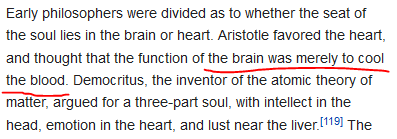
https://en.wikipedia.org/wiki/Brain#History
If 380 years BC, Aristotle was given a computer, would he be able to program a good chat bot? A chat bot that is at least as good as our current chat bots using neuronal networks? Teach Aristotle only how to program, don't reveal to him what brain does. Keep telling Aristotle that the only thing brain does is cooling blood. Would Aristotle be able to program a good chat bot?
I think yes.
Take heart for example - it could be replaced by various types of mechanical pumps. Each of these pumps using various principles of liquid propulsions. Does it matter how it pumps blood? It moves blood, that's what matters. It does not need to perfectly repeat the priciple of a real heart.
"Brain", “quantum”, “Mars” are just buzz words used nowdays to sell.
In my own opinion.
Not to mention that, repeating something and inventing something are two different things that deserve different merits.
Hypothetical case 1 - “Scientists managed to create an exact copy of a human brain made up of synthetic materials. And it thinks like a human.”
Hypotetical case 2 - “Scientists INVENTED a new approach to intelligence different than human brain and it is as intelligent as humans.”
Which of the two cases is more awesome?
In my own opinion it is the second.
Still, nowadays, some people try to sell inventions like that - “Our flying drone imitates the movements of a bird/bee. It is awesome because of that!”
What is awesome is how humans invented blade propellers rotating around a fixed axis. There is not such a thing in nature and we humans should be proud of our genuine invention as a species. But instead of that, people still try to copy and repeat. To plagiarize.
It is all related to the original topic - learning how brain works in order to be able to imitate it, or just completely ignore how brain works and create something completely new.
In my own opinion, second is better.
https://www.forbes.com/sites/fernandezelizabeth/2019/11/30/ai-is-not-similar-to-human-intelligence-thinking-so-could-be-dangerous/#1636a7926c22
Zero intelligence inside the code, just a mere tool -

https://link.springer.com/article/10.1007/s11023-019-09506-6
This is what our modern NNs and ML actually are -

A mere tool without its own intelligence, that we can tune to fit a task better than other.
In my own opinion.
Maybe the problem is people try to imitate a brain. Maybe this is the reason why humans are stuck with NNs. On YT i chatted with various users who preffer “a Logic Unit plus a Database” approach to AI. So, I am glad that not all of humanity is obsessed with NNs. Only 99.99% of humanity.
Note - I am not banning NNs, and ML. I am just stating the truth the way i see it. Maybe in the future somebody makes a slight change in NNs that changes it all and creates real intelligence. Who knows…
In my own opinion.
Topic Locked
This topic has been locked by a moderator. New replies are not allowed.