

The Top Ten Languages for Game Localization
Best languages for game localization. Analytics, market forecast, and case-studies. New and emerging gaming markets

There are numerous case studies, research projects, and forecasts regarding the most promising countries and languages for game localization. In this article, we’re going to examine the game language issue from the perspective of the most efficient allocation of your localization budget.

What are the highest- and lowest-priority objectives when it comes to game localization?
We suggest raising this question first before selecting localization languages. Why? Because, depending on the type of game you’re localizing, your business objectives, and your audience’s expectations, there are several levels of localization.
You can do the minimum required and stop at the first level, or you can go further with a step-by-step localization and maximize outreach.
The first thing to start with is the localization of keywords and game description for app stores. This alone might work perfectly well if your game has little to no text or voice and its interface design is fully compatible with the standards of the country you are targeting.
Next, if your game contains text-based instructions, you have no choice but to translate them. In addition, other design choices will also need adjustments in terms of colors, numbers, and other local standards.
Finally, voice-over, if present in the game, must be translated as well, or at least subtitled. Or you can fully complete the localization process by rerecording voice-over in your target languages, thereby providing the perfect user experience.
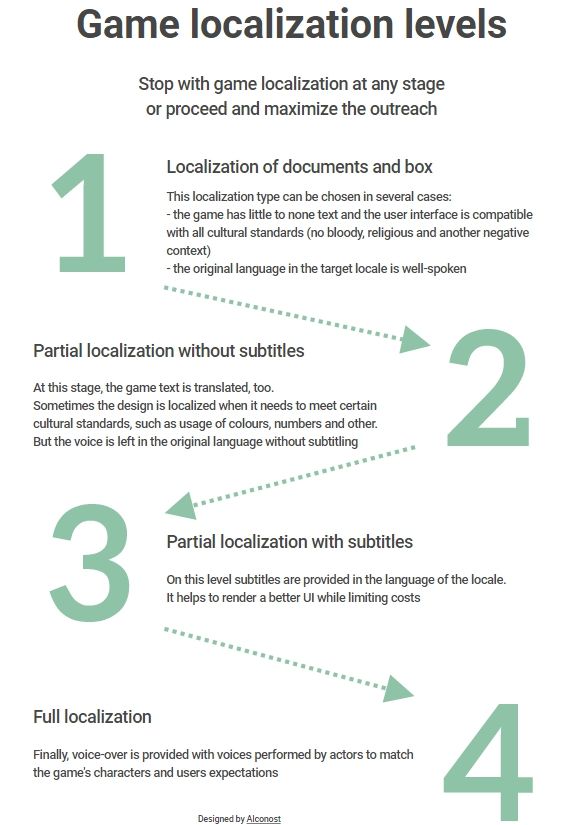
Our holistic judgment is that for some games such as, say, retro arcade-type games, the first level of localization is enough. However, for dynamic games involving lots of complex dialogs, instructions, and high-speed commands, full localization is the only acceptable option. In the end, it’s entirely up to you to decide how far to go with localization, but keep in mind that it will ultimately be the user experience that determines your project’s success.
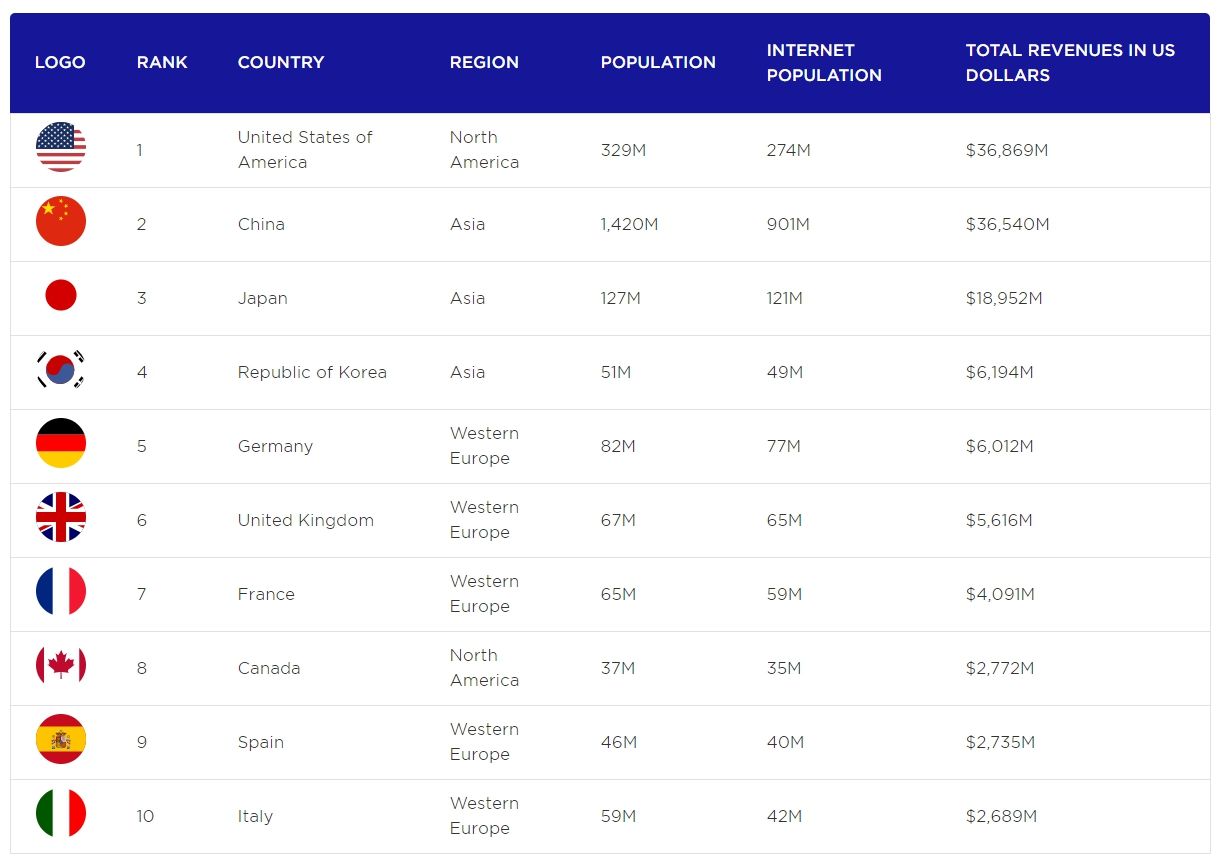
What are the most profitable languages for the games industry?
An overview of the segmentation of the games industry by profitability as of June 2019 was provided in a statistical report by Newzoo. However, when suggesting where to start with game localization, we shouldn’t just rush ahead and start at the top of the list, then work our way down. First of all, this is because Newzoo’s analysis is based on population, including internet users, and revenue from games. However, it doesn’t cover perspective markets, namely high-growth markets that represent the future of gaming and, as such, make every localization investment well-founded.
So what are the fastest-growing markets in the games industry?
According to another study by Newzoo, the fastest-growing region for games in 2018 was South Asia and the Pacific (+16.8% as of 2017), followed by Latin America (+13.5%). In addition, Globenewswire anticipates the fastest growth in South Asia and the Pacific region, particularly Indonesia and Thailand, with Vietnam and China (Taiwan) at the top for now. As for Latin America, according to Bizztech, the front-runners are Argentina, Brazil, and Mexico.
Mobile games are expected to lead the race
One remarkable observation is that the mobile-first approach that is widespread in the tech world is undoubtedly applicable to the games industry as well. For example, in 2018 the mobile games segment accounted for over 50% of the market’s 25.5% annual growth. This far outstrips the industry’s average of 13.5%. To make a long story short, this trend makes it clear that the focus of game localization should be shifted from Web to mobile applications.
Another notable and alarming fact is the restriction of the game localization process in China due to internal regulations. In fact, at the beginning of this year, the Chinese government introduced a new process for submitting games for review. Consequently, the release of localized games in China may become even more tedious and problematic. However, China will still remain a major contributor to the games market for the next couple of years, accounting for over a quarter of global games revenue.
What are the most popular languages for game localization right now?
Right now the most frequently-selected languages for game localization at Alconost are Japanese, Spanish, French, German, Simplified Chinese, Italian, English, Portuguese (Brazil), Korean, and Turkish.
However, Indonesian, Vietnamese, Thai, and Malay are swiftly gaining ground, and we expect these languages to appear even more regularly on our order lists within the next three years given the growth perspectives for the games market in South Asia and the Pacific.
As for Chinese, despite the recent snag pertaining to the approval of games by the country’s authorities, the market still shares the dominant position with the US. For example, take the success story of a client of ours and their game Punch Club. Just two weeks after being localized into Chinese, the game had already earned a Chinese market share equal to its existing share in the US.
What are the key languages and countries for game localization?
We’re getting close to sharing our recommendations for the best way to allocate your game localization budget. We definitely want to look at localization as a fair investment in the future of every game-related business and the industry in general.
To this end, we summed up the current status quo of key market players, trends, and forecasts, as well as case studies of over 1,500 of our clients. Then we drew up a list prioritizing the ten most essential languages that will drive the games market over the next couple of years:
- English — USA, UK
- Chinese, traditional and simplified — Taiwan, China
- Japanese — Japan
- Korean — South Korea
- German — Germany
- Spanish — Argentina, Mexico
- Portuguese — Brazil
- French — France, Canada
- Vietnamese — Vietnam
- Indonesian — Indonesia
Our best judgment is that you can never do wrong by localizing your game for one of these markets — your investment will always pay off. Good luck out there, and get ready for the gaming boom.
You might also find useful:
Games localization case studies
Top 10 languages for app localization
Disclaimer
This article has been contributed by Alconost, a global provider of product localization services for applications, games, videos, and websites into 70+ languages. We offer native-speaking translators, linguistic testing, a cloud platform with API, continuous localization, 24/7 project managers, and any format for string resources. We also make advertising and educational videos and images, teasers, explainers, and trailers for Google Play and the App Store.
Related Tutorials

Game videos from the Game Trailer Challenge: overview and breakdown with Alconost
We introduce personal top ten videos from the Game Trailer Challenge, analyze what made each particular video awesome, …
Alconost
Finland for Game Devs: A Little Country with Big Possibilities
Finland has become a focal point for leading gamedev companies from around the world: Ubisoft, Electronic Arts, Epic Ga…
Alconost

Join the Games Industry Roundtable and Make Your Mark on the Technology of the Future
Professional game developers can sign up today for industry insights, discussions and more.
 GameDev.net

Interview: How indie devs from a small Russian city make games for Google Play and social networks
Duck Rockets, an indie studio from Russia, shared their insights on the following: * why small local markets are more …
Alconost

RoKabium Games on Building a Game from the Ground Up
Interview with RoKabium Games on their success as a two-person indie developer studio.
 Steven Large

Interview: Game Design Careers with Byron Atkinson-Jones
In this interview, Byron discusses the best ways for young video game designers to get into the games industry.
Iain Twizzworks
Discussion
More from Kris Rusova

Creating game videos: best practices and pitfalls to avoid
Game video production: practical tips on how to create a game trailer or teaser that you can be proud of. Give your aud…
Alconost

5 Things to Consider When Making a Video to Promote Your App or Game
How can you show an app or game in your video in a way that attracts new users? Let’s take a look at what to go by when…
Alconost

How to Bring Your Chinese Game to Western Markets: the 5 Biggest Challenges and Solutions
With the home market being saturated, Chinese gaming companies have started going global. In this article, you'll lea…
Alconost
Discussion