
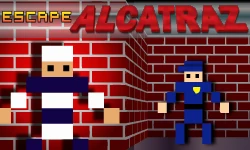
Redesigning an Old Game for Mobile Platforms
The process of turning a really antique and fairly unknown game into a brand new mobile title.

The Original Game
Alcatraz is an old Brazilian game, for an 8-bit system called MSX - a text-adventure game, with a twist: it uses a simple one-screen tile map to show the player avatar and some elements of the game. The premise of the game is quite simple: you're a prisoner on Alcatraz, and you have to escape.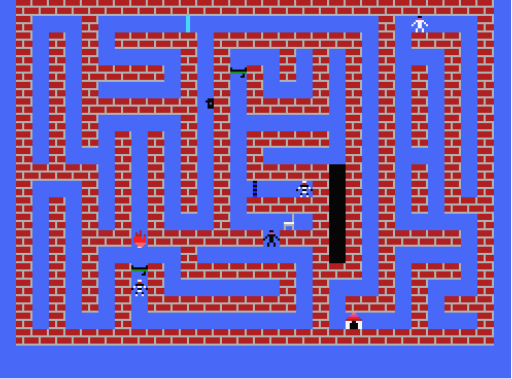 Alcatraz game map - the whole map.
 The Remake
I always wanted to remake this game - in some form or another, especially translating it into English, so it could reach a broader audience. Seeing the rise of mobile games, most of them very simple in their nature, I couldn't see a better opportunity to bring this very addictive game into the light. So, after choosing the mobile platform, one huge question remained: the original game was a text adventure. You had to type commands to get things done, and this obviously wasn't desired or even feasible on mobile. So a new way to play the game had to be created. This article is all about it: showing how the game was redesigned - with new visuals and improved gameplay, inspired by the old game on an 8-bit machine, to be able to run just about everywhere. Also, please take into account this game was developed just by me, in the time-span of exactly 2 months, so don't expect some AAA quality graphics on the screenshots :)The New Visuals
The first thing noticed was that the whole game visual wouldn't work on mobile - having the whole map on a single screen may have worked on MSX - but on mobile the graphics would be too small to be seen. This set the first game decision: the map would scroll with the player - so the game could have bigger graphics. In the original game the map was revealed as you walked by - but you could only see the tile where you were and 1 tile around it. I never liked that about the game, so I decided to make it a little better - the player would have a "view radius", and through some visibility checks (some basic ray casting) I would make the tiles far away fade into the darkness accordingly to their distance to the player - and even taking into consideration some other tiles (light passes through the prison bars, so you can actually see a little bit of the tile behind it, even if your passage is blocked). As in the original game, once you visited a tile, it would remain visible.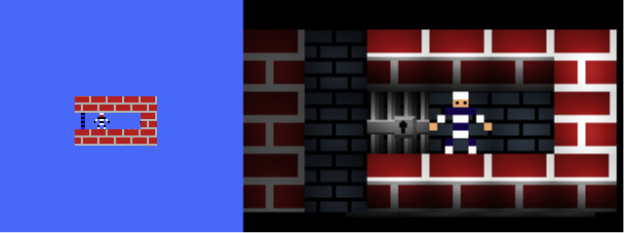 Visibility comparison: on the left, the original - you can't see beyond your position. On the right, the new version - you can see beyond the bars, the tiles to the left are a little darker, but visible.
 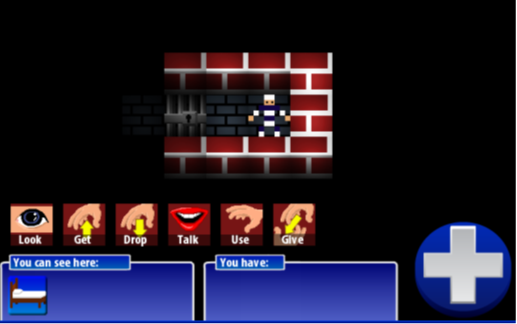 The new game interface: 6 possible actions the player can select with a touch.
 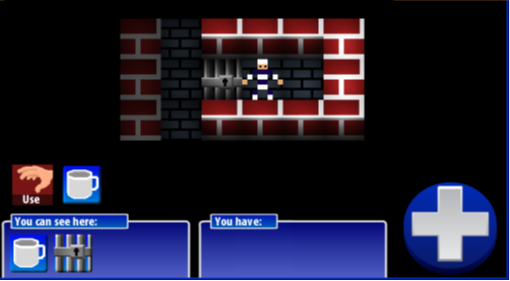 The game is waiting for you to use the mug somewhere.
 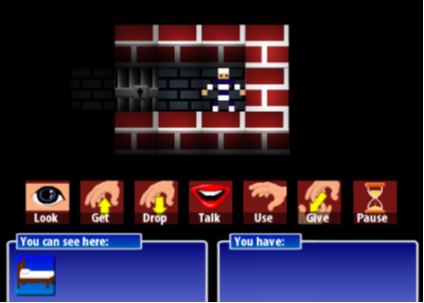 The interface, without the Virtual Joystick
 The New Gameplay
The original game was very fun - but probably due to memory restrictions (less than 32k!), it was rather short and the ending was a little abrupt. To improve things, the story was changed and expanded into three levels - the first one in the prison itself, and a second one, on the sewers below and a final third just outside the prison, but still on the island. Some parts of the original game were kept, so if you played the original, you will recognize some puzzles. But beyond that, the game got other improvements, especially regarding the NPCs. You could barely interact with NPCs in the original game: most of the time you could only give them something. This was changed, and now you can actually talk to them, and they react to a number of actions.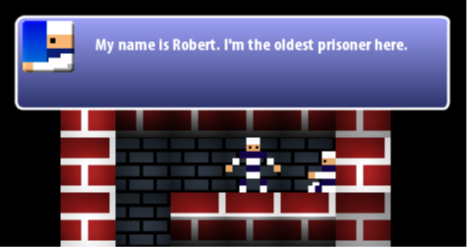
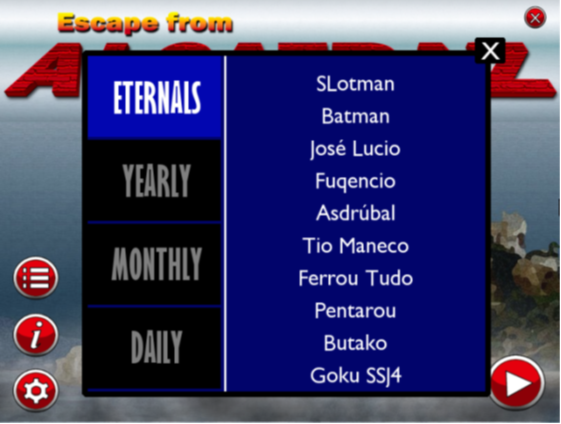 The game high score list, showing fake player names during testing :)
 Conclusion
As in most games, one plague haunted me: the feature creep. Even as I'm writing this article, new ideas for the game are popping up in my head. Some of them were implemented in the game (like the high score, the different endings, some new objects to interact with, even some jokes...) but there is a point when you must say: "that's it. It's done". When I first started this remake, the idea was to do it almost like the original, and in just a month. But so many ideas appeared, I couldn't let them all slip away. So what was supposed to be a 1 level game, became a 3 level one, with tons of extra stuff... and it took 2 months to get everything done. If you are curious about the game, you can play it for free on your Android device, and on iOS. You can check other games I've developed on my site: Icon Games. The primary tools used to develop this game were Photoshop for graphics, and for the programming, I used a language called "Monkey", which is free for HTML5 games and allows a game to be easily ported to several platforms.Article Update Log
31 May 2013: Initial release 1st June 2013 Changed article image and added Wikipedia link to MSX 7 June 2013 Fixed links on article. 11 June 2013 Added iTunes link for iOS.Related Tutorials

Lesson 1 — What C# Actually Is
Why is C# the language driving the production of thousands of indie games using Unity and custom engines all around the…

Steps to Make a Simple Game in Unity
if you’re diving into game development, Flappy Bird is basically the ‘hello world‘ of the gaming universe. It is the ul…
.webp)
Automatic Tutorial Creation for Unity | No AI | No more time waste
Automatic Tutorial Maker (ATM) for Unity is a tool that automates in-game tutorial creation by recording developer acti…
Save and Load System for Godot 4 – Tutorial
Saving and loading game data is a crucial feature for any game, as it allows players to continue their progress even af…
 FreeTimeDev

Unity Finite State Machine Tutorial
Comprehensive tutorial on utilizing finite state machines (FSMs) in Unity game development. It explains the concept of …

Project Structure - Guide to Cocos Cyberpunk Source Code
In my previous post, I mentioned that I would be write a series of articles on Cocos Cyberpunk. So let's kick off with …
 Mr. Kylin
Discussion