

Advertising Your Games
Advertising has always been a rough market. Not only is it extremely competitive, expensive, and risky, but it also changes as fast as any market. Get some advice on making it work for you.
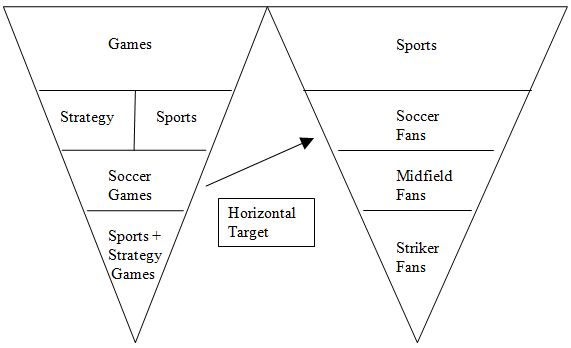
This article was meant to revise and conclude a marketing series published on GameDev.net back in 2004. In 2008 it was included in the book Business and Production: A GameDev.net Collection, which is one of 4 books collecting both popular GameDev.net articles and new original content in print format.In order of importance these terms are: 1) Bulls-Eye Targeting 2) Competitor Targeting 3) Horizontal Targeting 4) Vertical Targeting Bulls-Eye: The key to successful advertising is targeting the ads to the users most likely to purchase your product. Seems like a no-brainer, right? Unfortunately the trouble typically comes from figuring out who the heck your target market really is and once you do figure it out, how do you go about reaching them? In order to determine the most targeted user we start at the very highest level of user interest and awareness. This is, in fact, people who are interested in your game specifically. Once again, the sad fact is unless you have a pre-existing audience then this group of people is pretty small. Still, advertising to your own audience tends to be dirt cheap and super-effective. Do not fret and worry about your pre-existing users not liking a sudden e-mail from the developer. I find that while you will get a few complaints, the impact of such a thing is tremendously positive for sales and growth. Competitor Targeting: This leads us to the next group, people who are interested in similar games to yours. I'm not talking about people who like Risk also liking some board-strategy game; I am talking about the people who have cloned another game in part or in whole. This is where Google and other contextual/search ads come in most handy. Advertising on the keywords of your competitor's products gives you an opportunity to piggyback on their success. Nothing in advertising is easy though, and what you're going to find is that most of the people looking for a specific product are not looking for an alternative. This means you'll be bidding less than everyone else and won't be able to pull big volume even on a popular game. Still, if you have a hidden object game and put an ad on every other hidden object game's name you'd probably do enough volume to make it worthwhile. Horizontal Vs. Vertical Targeting: Before we dive into the next two an explanation is necessary about the difference between them. This applies to all industries, so it's a rather useful concept you are certain to run into again some day. Vertical and horizontal are both all about getting into the mind of the consumer, which makes it a rather tricky thing to define. Vertical refers to drilling "down" into the sub-divisions of human interest. Creepy as it sounds, it is best described by example. A vertical chain looks like this: I like games. I like sports games. I like strategy games. I like sports games. I like sports strategy games. You can move up or down this chain to increase or decrease the targeting. Each level of vertical "down" is a better target, but as you may suspect - a smaller one as well. So far we've been very far "down" the vertical chain, so the next area we'll go up the vertical chain a little, making things less targeted but still within the vertical area. Vertical markets are all the rage these days, probably because they clearly make sense. Horizontal is in reference to the "breadth" of the interest level of a particular group. This makes a whole lot less sense, and you'll find tons of different definitions of a horizontal "market" out there. One person I know defines a horizontal only as a product with near-universal appeal. Spreadsheet software or games as a whole could also qualify. An ad targeting to anyone who enjoys games would be a horizontal ad, this ad could appear in any website and because of its universal appeal, attract attention no matter what. I say that's a load of bunk and I simply call these things universal products/ads. So how do I define it horizontals. Visualize a point-down triangle. Draw 3 horizontal lines in that triangle. The top and broadest area in our example above is "I like games" while the bottom is "I like sports strategy games." Where we said "I like sports games" we'd draw a vertical line and also write "I like strategy games." This is an example of two different horizontals occupying very close proximity. Not mentioned above is the very high likelihood of this person saying "I like sports." Here we have a completely separate triangle (vertical). It would appear horizontally across from "I like games." In that triangle "I like soccer" would be below it, horizontally across from "I like soccer games." This is where I derive the idea of a "horizontal" target. Because games are a universally enjoyed commodity (Yeah ok, let's just say it is), then you can clearly advertise in a vertical market connected to your horizontal chain! Time for a shoddy picture!
Related Tutorials

Interview: How indie devs from a small Russian city make games for Google Play and social networks
Duck Rockets, an indie studio from Russia, shared their insights on the following: * why small local markets are more …
 Alconost

RoKabium Games on Building a Game from the Ground Up
Interview with RoKabium Games on their success as a two-person indie developer studio.
 Steven Large

Interview: Game Design Careers with Byron Atkinson-Jones
In this interview, Byron discusses the best ways for young video game designers to get into the games industry.
 Iain Twizzworks

Interview: Cliff Harris on What it Takes to Become a Successful Game Developer
Game designer, programmer, and running a one-man games business, Cliff Harris of Positech Games is behind strategy and …
Tony Chan

Challenges of a VR Indie Developer: Interview with Eric Nevala of Wobbly Duck Studios
Wobbly Duck Studios founder Eric Nevala (@slayemin is his profile here on GameDev.net) has been documenting the develop…


How to Become a Game Designer - Interview with Game Design Professor, Al Doyle
Iain Fenton interviews Al Doyle, professor of game design at New York's Tuoro college, and discusses in length the best…
Iain Fenton
Discussion
More from Joseph Lieberman
Reverse-Normal 3d Outline Tutorial
A simple trick for getting a crisp outline on a 3d mesh.

Color Palettes
Creating a custom color palette can be a very satisfying and powerful way to establish your own unique look. I'll guide…
Composition 101: Balance
What are the principles of Balance in Composition? Otto Ostera discusses the 3 elements of balance: shape, direction, a…
Discussion